
Chair no. 17 - Horace Engdahl
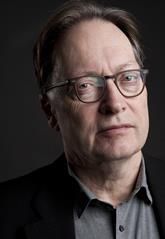 Author and literary historian.
Elected: 1997.
Horace Engdahl’s accomplishments as a literary historian have included both introducing previously unknown authors and providing new interpretations and re-evaluations of those who seem familiar.
Horace Engdahl was born in Karlskrona in 1948. In the 1970s, he was one of the founders of the cultural magazine Kris, whose influence on the intellectual and literary climate in Sweden can barely be overestimated. In 1987, he defended his thesis entitled Den romantiska texten. En essä i nio avsnitt (The Romantic Text. An Essay in Nine Sections), which is essentially a re-examination and re-evaluation of Swedish Romanticism. By this time, he had already established himself as a leading critic within the fields of literature and dance. From 1989 to 1998, he was employed on the cultural editorial team of the newspaper Dagens Nyheter and, towards the end of the same period, worked for Sveriges Television. He was also a founder of the Kykeon series of publications, for which he introduced and translated texts by writers who had previously been ignored in Sweden, such as Maurice Blanchot. His translation work also includes German plays by Gotthold Ephraim Lessing, Heinrich von Kleist and Arthur Schnitzler. In addition, he produced a complete translation from the original French of Queen Christina’s Maxims, which was published in the Swedish Academy’s Classics series in 2019.
Books such as Stilen och lyckan (Style and Happiness, 1992) and Ärret efter drömmen (The Scar from the Dream, 2009) solidified Engdahl’s place as one of Sweden’s most important and influential essayists. Stilen och lyckan includes the first comprehensive examination of Erik Beckman’s work (originally published in the literary magazine Bonniers Litterära Magasin in 1984). In Beröringens ABC (The ABC of Touching, 1994), Engdahl examines the literary voice, the silent companion that makes itself heard in the midst of our reading, telling us what is meant by the written word. His later work also includes a large number of aphorism collections, for example in Cigaretten efteråt (The Cigarette Afterwards, 2011), Den sista grisen (The Last Pig, 2016) and De obekymrade (The Unperturbed, 2019). In 2021, he published a collection of reflections titled Op. 101, and in Spårvagnsresor med Mr Hume (Tram Travels with Mr. Hume (2023), he engaged in conversation with the 18th-century Scottish philosopher David Hume, interspersed with essays based on their topics of discussion. This was followed by Ugglor i mossen: Tankar om idiom, in which Engdahl examines a number of favorite Swedish idioms and the light they shed on language and human nature.
His latest work is a collection of observations and short essays entitled Op.101 (2021).
In 1997, Horace Engdahl was elected to the Swedish Academy as successor to the author Johannes Edfelt and, from 1999 to 2009, he held the position of Permanent Secretary of the Academy. He has previously also been a member of the board of the Royal Swedish Opera and an adjunct professor of Nordic literature at Aarhus University.